Interpretation of awakening_song
“Through the round of many births I roamed
without reward,
without rest,
seeking the house-builder.
Painful is birth
again & again.
House-builder, you're seen!
You will not build a house again.
All your ribs broken,
the house-rafters departed from fabrication (saṅkhata) of the house.
Departed from fabrications (saṅkhara), the mind
has attained to the end of craving.” (Dph. 153~154)
Chapter 1 : Satta (ordinary people)
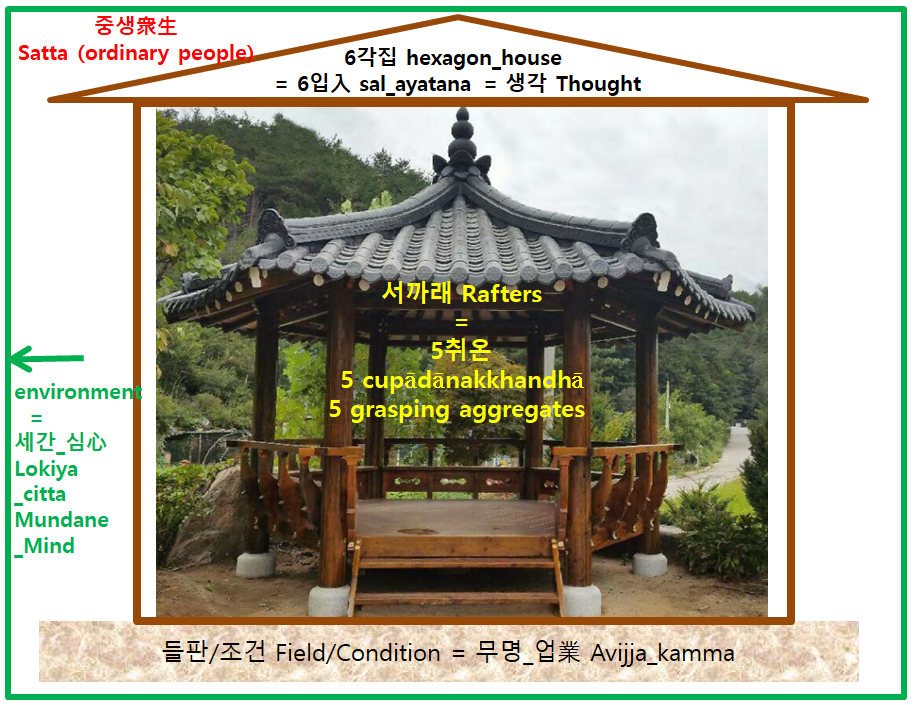
Step 1 : Decide who will build the house.
You can do it yourself, or you can leave it to others. Is the House-builder appearing on the verses me or someone else? It is explained in detail in step 9.
Step 2 : Select the environment in which the house would be built.
Ordinary people build a house in an lokiya_citta (mudane_mind) environment and holy people build in a lokuttara_citta (supermudane_mind) environment. The minds(citta) of the saints who overcome the avijja(unknowing) after realizing 4_noble_truth turned to Nibbana. The mind(citta) that arises when Nibbana could be targeted(sati) is lokuttara_citta (supermudane_mind).
“So too a bhikkhu who develops and cultivates the 8_fold Noble Path slants, slopes, and inclines towards Nibbāna.” (SN45:91)
Step 3 : Prepare the land for the house.
The land of the ordinary people is their avijja_kamma (unknowing_deed). In this writing, holy people's kamma (deed) is called as vijja_kamma (holy_deed), and ordinary people's avijja_kamma (unknowing_deed) for convenience.
“Thus kamma is the field ...” (AN3:76)
“Salayatana fabricated from old kamma as condition ...” (SN35:146, SAii402) SA:Saratthappakasini
Step 4 : Prepare the materials for building a house.
The material (house-rafters) for building a house is pañcupādānakkhandhā(the 5 grasping aggregates ; rupa, vedana, sanna, saṅkhara, vinnana).
“Thus kamma is the field, consciousness the seed, and craving the moisture.” (AN3:76)
“The eye ... Sights(rupa) ... Eye consciousness(vinnana) ... Eye contact ... Feeling(vedana) ... The ear … nose … tongue … body … mind(mano) should be given up by direct knowledge and complete understanding.” (SN35:25)
Step 5 : Work is underway to build a house.
The construction work to build the house is to re_fabricate (abhisaṅkharontī) fabricated pañcupādānakkhandhā(saṅkhata : the 5 grasping aggregates) for the sake of pañcupādānakkhandhā-ness.
“And why do you call them 'fabrications (saṅkhārā)'? Because they re_fabricate (abhisaṅkharontī) fabricated things (saṅkhata) , thus they are called 'fabrications.' What do they fabricate as a fabricated thing? For the sake of form-ness, they fabricate form as a fabricated thing. For the sake of feeling-ness, they fabricate feeling as a fabricated thing. For the sake of perception-hood... For the sake of fabrication-hood... For the sake of consciousness-hood, they fabricate consciousness as a fabricated thing.” (SN22:79)
Step 6 : The house is completed.
The name of the completed house is Salayatana(6_ sense bases). According to the suttas below, Salayatana is nothing but the ‘thought’ of humans because Salayatana is called the all or the world. In other words, If there is no thought
(Salayatana) of human there is no world or nothing.
“What is the all? Salayatana is called the all.” (SN35:23)
“Salayatana is called the world in the Noble One’s Discipline.”(SN35:84)
Step 7 : The old house is demolished.
When the land on which the house stands is extinguished, the house is forced to collapse.
“And what, bhikkhus, is the cessation of kamma? When one reaches liberation through the cessation of bodily action, verbal action, and mental action, this is called the cessation of kamma.” (SN35:146)
Step 8 : The craving to build a better house disappears.
The holy people no longer have a craving for a new house. But their holy_deed automatically creates a new house (sal_ayatana without desire and lust). (ref. chapter 2)
“The five aggregates are indeed burdens,
and the person is the bearer of the burden.
Picking up the burden is suffering in the world,
and putting the burden down is happiness.
When the heavy burden is put down
without picking up another,
and craving’s pulled out from the root,
you’re hungerless, extinguished.” (SN22:22)
Step 9 : The identity of house-builder is known.
The reason Gottama is called Buddha is because He found 4_noble_truth. Given that ‘house-builder’ appearing in the awakening_song was finally found after reincarnation of Gottama's numerous lives, ‘house-builder’ must be 4_noble_truth, a sign of Buddha. 4_Noble_Truth inside the ordinary peoples is an avijja_4_Noble_Truth that works in the state of avijja(which hasn't been found it yet). The meaning of the phrase “All your ribs broken” in the awakening_song is ‘destroying the avijja(unknowing).
“But when my true knowledge and vision about these four noble truths was fully purified in these three perspectives and twelve respects, I announced my supreme perfect awakening in this world with its gods, Māras, and Brahmās, this population with its ascetics and brahmins, its gods and humans.” (SN56:11)
Chapter 2 : Ariya (holy people)
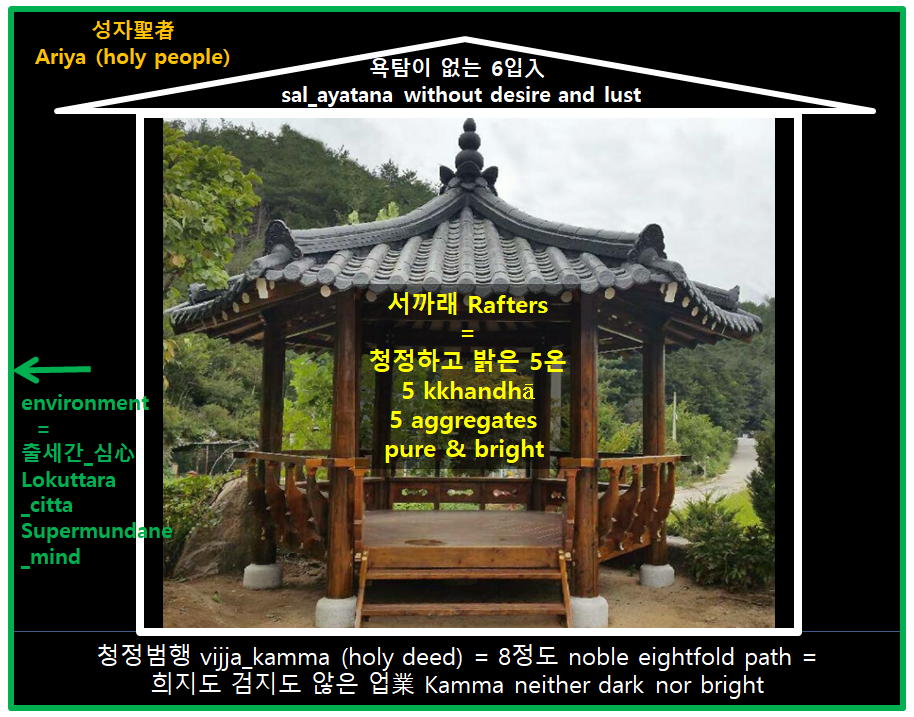
1. vijjā(true_knowledge)
True_knowledge is knowledge of 4_noble_truth.
“Bhikkhu, knowledge of suffering, knowledge of the origin of suffering, knowledge of the cessation of suffering, knowledge of the way leading to the cessation of suffering: this is called True_knowledge.” (SN56:18)
2. vijja_kamma(holy_deed)
Holy_deeds of 8_fold Path is vijja_kamma.
“There are neither dark nor bright deeds with neither dark nor bright results, which lead to the ending of deeds.” (AN4:232)
“And what is the spiritual path that leads to extinguishment? It is simply this noble eightfold path, that is: right view, right thought, right speech, right action, right livelihood, right effort, right mindfulness, and right immersion. This is the spiritual path that leads to disillusionment, dispassion, cessation, peace, insight, awakening, and extinguishment.” (D19)
3. vijja_5_kkhandhā(the 5 aggregates pure and bright)
The 5 aggregates pure and bright pure and bright are vijja_5_kkhandhā.
“There remains only consciousness: pure & bright.” (MN140)
“Seeing thus, the instructed disciple of the noble ones grows disenchanted with form, disenchanted with feeling, disenchanted with perception, disenchanted with fabrications, disenchanted with consciousness. Disenchanted, he becomes dispassionate. Through dispassion, he is fully released. With full release, there is the knowledge, 'Fully released.' He discerns that 'Birth is ended, the holy life fulfilled, the task done. There is nothing further for this world.'
This, monks, is called a disciple of the noble ones who neither builds up nor tears down, but who stands having torn down; who neither clings nor abandons, but who stands having abandoned; who neither pulls in nor discards, but who stands having discarded; who neither piles up nor scatters, but who stands having scattered.” (SN22:79)
4. vijja_Salayatana(holy six sense bases)
Holy people’s Salayatana without desire and lust is vijja_Salayatana.
“The Blessed One sees a form with the eye, yet there is no desire and lust in the Blessed One” (SN35:232)
5. magga(8_fold Path)
The first step ‘right view’ of 8_fold Path is attaining of the vijjā(true_knowledge). Therefore, the 8_fold Path(magga) starts only after finding the 4_noble_truth within me.
“And what is right view? Knowing about suffering, the origin of suffering, the cessation of suffering, and the practice that leads to the cessation of suffering. This is called right view.” (SN45:8)
6. cessation of avijja_kamma(unknowing_deed)
Gottama also liberated through Eightfold Path(magga) after realizing the 4_noble_truth. Even if you get the vijjā(true_knowledge), all avijja_kammas will not disappear at once. In order to extinguish a certain avijja_kamma, the practicing level of the corresponding vijja_kamma must be reached at fourth jhana (without pleasure & pain, with pure equanimity & mindfulness) until the pending avijja_kamma demolished.
“Tathagata has awakened to the middle way (Eightfold Path), which gives rise to vision, which gives rise to knowledge, which leads to peace, to direct knowledge, to enlightenment, to Nibbāna.” (SN56:11) fin.
.(2020.8.2)
[이전] [위로] [다음]